The Pen is Mightier than the Algorithm: Why AI Mastery Requires Creative Writing

In this article
The Irony of AI's Dependence on the Arts
AI may run on bits and bytes, but it thrives on language and imagination. The massive language models behind today's chatbots and content generators learned to communicate by digesting millions of pages of human writing – novels, articles, forum posts, you name it. Modern AI "stands on the shoulders of widespread human efforts". It's ironic: a technology often seen as cold and computational is utterly reliant on the richness of human speech, literature, and creativity.
Whenever you ask a question to ChatGPT or another AI, the quality of the response depends on how well the question is framed – or, prompted. A vague prompt leads to a vague answer, but a carefully worded prompt elicits a precise and insightful response. AI is a communication technology at its core, and to communicate effectively with it, we need the skills honed by those with a creative edge: understanding context, choosing the right words, and crafting a narrative.
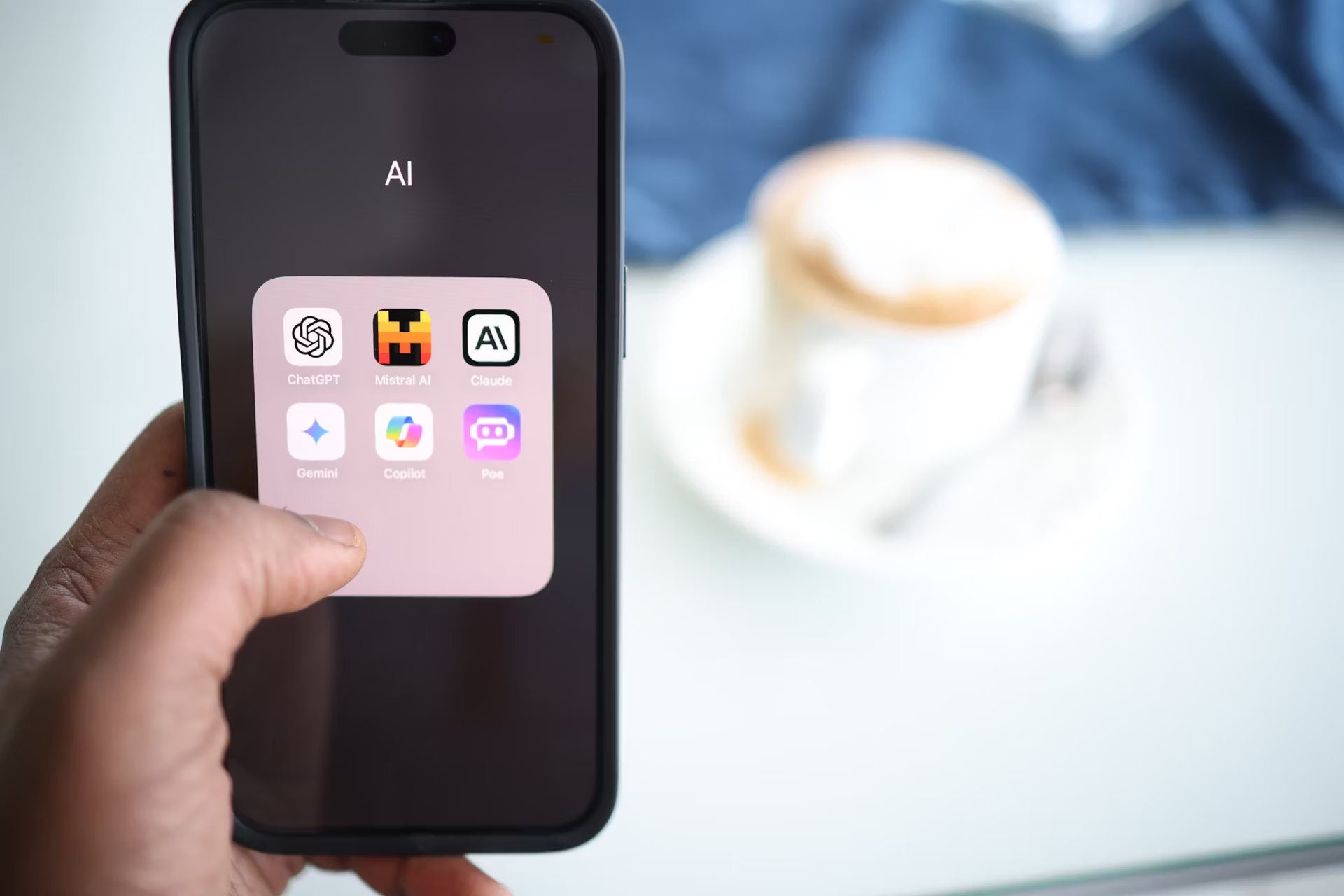
I can attest to this too. Taking that extra minute to structure your needs and clearly articulating the end game in a considered prompt will have Claude or Gemini giving you what you want in a matter of a few thousand tokens.
Prompt Engineering: An Art, Not Just a Science
So, this for me is the big one! If you've experimented with AI tools, you'll know that prompt engineering – the craft of writing inputs to get good outputs – is a skill of its own. Unlike traditional coding, where instructions are shall we say "explicit", prompting AI requires nuance and tone. You're not writing code; you're writing dialogue. Akin to the back and forth of an Australian Open five setter, we often go back and forwards with our new AI overlords to finally get what we want.
But it doesn't have to be a marathon effort. Some hallmarks of effective prompts include:
• Rich context and detail: Providing background so the AI isn't guessing what you mean.
• Tone and style cues: Specifying whether you want a formal report, a playful blog post, or a heartfelt story.
• Clear direction with creativity: Asking for exactly what you need while leaving room for the AI's generative flair.
• Open-ended prompts: Encouraging elaboration by setting a scenario rather than a strict command.
Crafting such prompts is truly an art form. It requires anticipating how the AI might interpret phrases and steering it toward the desired outcome. As one AI expert notes, "the more specifically and creatively you can describe what you need, the better the AI's response will be."
Balancing STEM and Creative Subjects in Education
For years, I feel like students have been nudged into STEM fields – science, technology, engineering, maths – often at the expense of the arts and humanities. The assumption has been that coding and data skills are the future, while literature and history are less valuable. But as AI advances, this overemphasis on STEM is showing its downside. Without the humanities, we risk creating technology experts who can build powerful AI tools but lack the creativity and critical thinking to use them effectively.
We can already glimpse this future taking shape. Some braver than I in predicting the future even argue that in the coming years, arts students may have an edge in the job market over those with purely technical degrees. The rationale is that this education brings a broader perspective. That they're trained to weigh ethical implications, consider societal impact, and understand human behavior. When teamed up with engineers, they help create AI products that are not only technologically sound but also user-friendly, fair, and imaginative.
AI can write a passable news article or generate code from comments, but it still takes a human writer to decide what story needs telling and why a piece of software should exist in the first place. As automation accelerates, our uniquely human capacities for imagination and moral reasoning become the X-factor that sets great innovations apart.
The Future of AI and Creativity
Far from making the humanities obsolete, AI is actually making creative skills more valuable. As AI takes over routine problem-solving, what remains for humans is the higher-order work: imagination, ethical reasoning, and strategic thinking. AI can write a decent news article, but it still takes a human to decide what story needs telling and why it matters.
We're entering an era where the ability to write, create, and think critically will define how well we leverage AI's potential. Digital marketers, for instance, will find that their knack for storytelling isn't just safe from automation – it's actually the key to making AI work for them. In a world of smart machines, it's those who can communicate with clarity, creativity, and heart who will lead the way.